Paravalvular leak Closure

What is Paravalvular leak Closure?

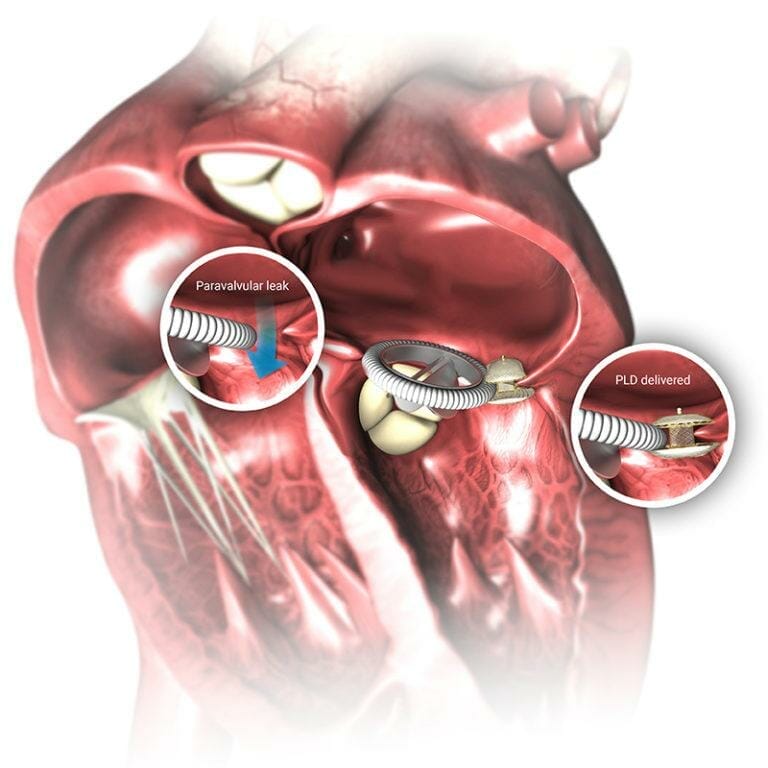
Patients who have had a previous surgical valve replacement (either mechanical or a tissue valve) can sometimes develop a leak around the outside of the valve – a so called paravavular leak (PVL). Although this does not necessarily cause any problem, it can result in symptoms. Symptoms include breathlessness, tiredness and leg swelling – as with any type of mitral valve leak. 

The symptoms of PVL can either be due to the effect of blood leaking backwards into the left atrium or sometimes due to breakdown of red blood cells through the PVL hole. This is called haemolysis and can result in anaemia which can require repeated blood transfusion.

Do I need PVL Closure?

Do I need PVL Closure?

The need for PVL closure usually depends on the size of the PVL, the amount of blood leaking back into the left atrium and the presence of haemolysis related anaemia. We will usually suggest a CT scan and transoesophageal echo (TOE) to help decide if PVL closure is appropriate and technically possible.

How is it undertaken?

How is it undertaken?

If the PVL needs to be closed, this can be done by repeat open heart surgery. Otherwise we can consider percutaneous PVL closure which is carried out from the groin usually via the femoral vein. Sometimes we also need to use the femoral artery, depending on how we plan to access the valve. Under a general anaesthetic, a wire is advanced through the PVL and the hole is closed with a soft metal plug. In the majority of cases, PVL closure is performed at low risk with a more than 90% chance of success of reducing the leak and improving symptoms.

Our Team
Toufan Bahrami


Mr Toufan Bahrami is a senior consultant in cardiac surgery , working at both Royal Brompton and Harefield Hospitalwhere he treats both NHS and private patients.

He also works at The Harley street clinic in central London .With more than 4000 cardiac operations of which 1500 are minimally invasive procedures over past 21 years, He is the   only consultant in UK expert in all aspects of minimally invasive cardiac surgery including , Mitral , Aortic valve and root and CABG with a longstanding track record.

Saeed Mirsadraee


Dr Mirsadraee’s specialist interest is cardiovascular imaging and in particular imaging of the heart valves, surgical and transcatheter aortic and mitral valve procedure planning, and complex aortic conditions. He is the radiology lead for aortic and mitral imaging at the Royal Brompton and Harefield hospitals. Dr Mirsadraee uses CT images in planning Mitral valve procedures such as minimal access mitral valve surgery, transcatheter mitral valve implantation (eg. Tendyne, Sapien in ring/MAC), cord and left ventricular remodelling procedures (eg. Accucinch, Neocord).

Ali Vazir


Dr Ali Vazir is a consultant cardiologist based at the Royal Brompton and Harefield Hospitals, part of Guy’s and St Thomas’ NHS Foundation Trust. He is also an Honorary Clinical Senior Lecturer at National Heart and Lung Institute, Imperial College London. 

He is an expert in heart failure and echocardiography. He is the clinical lead for heart failure at the Royal Brompton Hospital. He trained in London and was a Post-doctoral research fellow at the Brigham and Women’s Hospital and Harvard Medical School, Boston, USA. He is a principal investigator for several multicenter trials. 

Lauren Connolly

Lauren has worked within the cardiology and cardiac surgery care setting for seven years. In recent years she has worked within the structural heart team as clinical nurse specialist and co-ordinator for the trans catheter team, specifically focusing in mitral and tricuspid valve disease.

Dr Robert Smith

Dr Smith’s specialist interest is Mitral valve disease and interventions. He leads one of the largest structural heart disease programmes in Europe at the world renowned Royal Brompton & Harefield Hospitals. It is also the first centre of excellence for MitraClip in the world.